





Waterjet Intensifier Pump vs Direct Drive Pump: Key Differences
Waterjet cutting machines use ultra-high-pressure pumps to generate the water stream required for cutting metal, Stein, glass and other materials. The two main pump technologies are hydraulic intensifier pumps and direct drive pumps.
Although both generate high-pressure water, they differ in operating principles, energy efficiency, maintenance requirements and pressure capabilities. Understanding these differences helps equipment manufacturers and operators select the right pump for their production needs.
1. How Does a Waterjet Intensifier Pump Work?
A waterjet intensifier pump uses hydraulic pressure to generate ultra-high-pressure water.
An electric motor drives a hydraulic pump, which supplies pressurized oil to a large hydraulic piston. The piston drives a smaller-diameter ceramic plunger, multiplying the pressure through the difference in surface areas.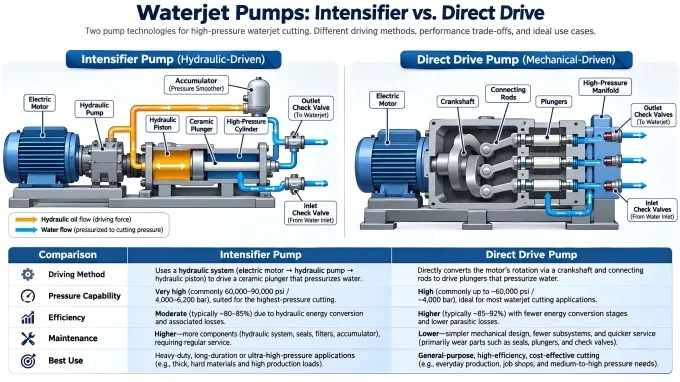
Key characteristics include:
-
High water pressure, with advanced systems supporting up to approximately 90,000 PSI.
-
Hydraulic-driven reciprocating operation.
-
Suitable for demanding industrial cutting applications.
-
Longer maintenance intervals in many conventional designs.
Intensifier pumps are commonly used in industrial applications requiring high pressure, consistent output and demanding production performance.
2. How Does a Direct Drive Waterjet Pump Work?
A direct drive pump uses an electric motor connected to a crankshaft, which drives multiple plungers to pressurize water directly.
Unlike an intensifier pump, it does not require a separate hydraulic power system to multiply pressure.
Its main characteristics include:
-
Direct mechanical power transmission.
-
Higher energy efficiency in comparable operating conditions.
-
Compact mechanical design.
-
Typically lower initial equipment cost.
-
Commonly operates at pressures up to approximately 60,000 PSI.
Direct drive pumps are often suitable for workshops prioritizing energy efficiency and standard waterjet cutting applications.
3. Intensifier Pump vs Direct Drive Pump: Key Differences
| Comparison | Intensifier Pump | Direct Drive Pump |
|---|---|---|
| Driving method | Hydraulic piston | Motor-driven crankshaft |
| Pressure capability | Can reach approximately 90,000 PSI | Typically up to 60,000 PSI |
| Energy efficiency | Generally lower | Generally higher |
| Initial investment | Often higher | Often lower |
| Instandhaltung | Typically longer service intervals | More frequent seal maintenance in many designs |
| System structure | Hydraulic and high-pressure systems | Direct mechanical drive |
| Main application | Demanding industrial cutting | Standard industrial cutting |
Actual performance, service life and operating costs depend on pump design, Betriebsdruck, water quality and maintenance practices.
4. Which Waterjet Pump Should You Choose?
The right choice depends on production requirements and operating costs.
Choose an intensifier pump if:
-
Your application requires higher cutting pressure.
-
You process thick or demanding materials.
-
Long maintenance intervals are important.
-
Your production setup requires flexible high-pressure delivery.
Choose a direct drive pump if:
-
Energy efficiency is a major priority.
-
Your application uses standard cutting pressures.
-
You prefer a more compact mechanical system.
-
Lower initial equipment investment is important.
Neither technology is universally better. Evaluate pressure requirements, cutting volume, maintenance resources and total operating costs before making a decision.
5. Waterjet Pump Maintenance and Replacement Parts
Both pump types require regular inspection to maintain cutting performance.
For intensifier pumps, common replacement components include:
-
Hochdruckzylinder
-
Ceramic plungers
-
Hydraulische Kolben
-
Check valves
-
Hochdruckdichtungen
-
Accumulators
For direct drive pumps, maintenance commonly involves plunger seals, Rückschlagventile, crankshaft-related components and other high-pressure parts.
Selecting replacement parts requires accurate model identification, dimensional compatibility and suitable material specifications.
Waterjet Intensifier Parts Supplier – DAS
Choosing the right pump technology is only part of maintaining a reliable waterjet cutting system. Component quality and timely replacement also affect equipment performance and service life.
KAD supplies waterjet intensifier pump components, including high-pressure cylinders, Keramikpümpfer, Hydraulische Kolben, seals and related replacement parts.
With precision machining and customized manufacturing support, KAD serves waterjet equipment manufacturers, maintenance companies and industrial parts distributors.
Contact KAD for waterjet intensifier replacement parts and customized component solutions
